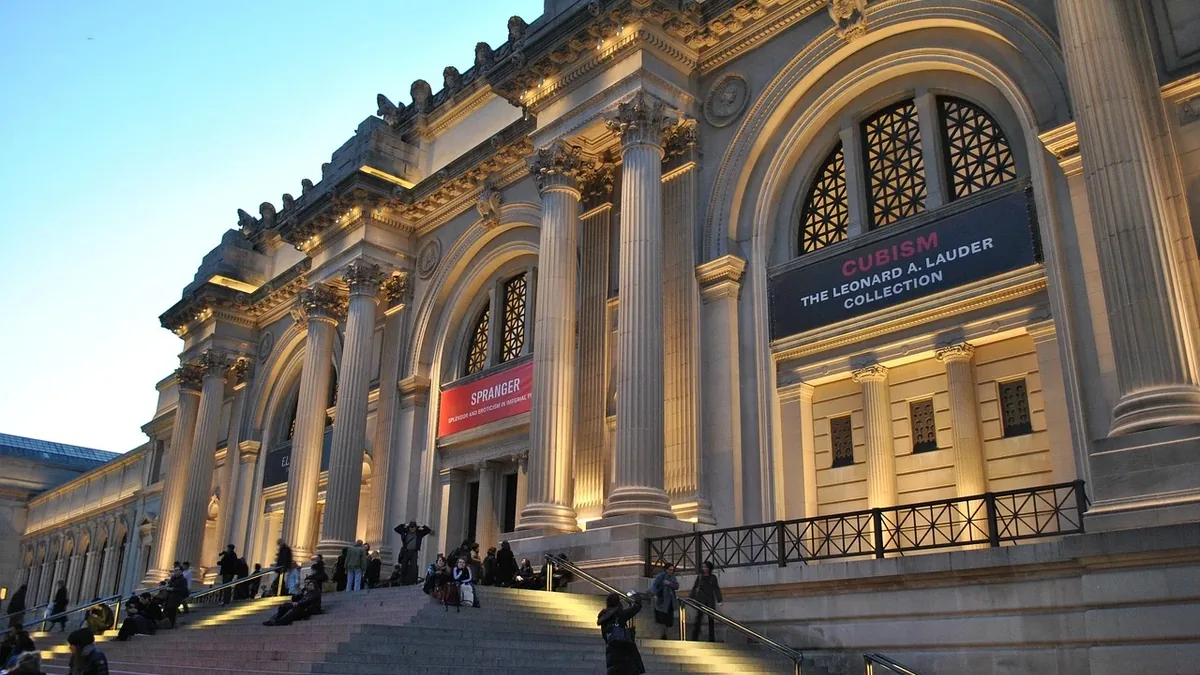
The Met
| Founded | 1870 |
|---|---|
| Location | New York City, New York, USA |
| Type | Art museum |
| Collection size | Over 2 million works |
| Areas | European paintings, American art, Ancient art, Arms and Armor, Costume Institute |
| Architectural style | Beaux-Arts |
| Governing body | Board of Trustees |
Overview
The Metropolitan Museum of Art, commonly known as The Met, is a preeminent encyclopedic art museum located in New York City. Its collection spans over 5,000 years of art from every corner of the globe, encompassing works from antiquity to the present day. The institution operates three distinct sites: The Met Fifth Avenue, The Met Cloisters, and The Met Breuer, though the Breuer location is currently closed for future programming. It functions as both a public museum and a major research institution, with extensive libraries and conservation laboratories. The Met's mission centers on collecting, studying, conserving, and presenting significant works of art to connect people to creativity, knowledge, and ideas. It serves as a cultural anchor for the city and a destination for international visitors, offering a vast and deep exploration of human artistic achievement.
History
The Metropolitan Museum of Art was founded in the United States in the 1870s by a group of American citizens including businessmen, financiers, artists, and thinkers. Its creation was driven by a desire to bring art and art education to the American people and to establish a world-class museum in New York City. The museum first opened its doors in 1870 in a temporary location before moving to its permanent building on Fifth Avenue along the eastern edge of Central Park in the 1880s. Its collection grew rapidly through purchases and donations from prominent collectors, beginning with a Roman sarcophagus and 174 European paintings. Landmark architectural expansions throughout the 20th century, including the addition of the American Wing and the Temple of Dendur, accommodated its ever-growing holdings. The Met Cloisters, dedicated to medieval European art, opened in a separate location in Fort Tryon Park in the 1930s, funded primarily by John D. Rockefeller Jr.
How it works today
The Met operates as a non-profit organization governed by a board of trustees responsible for its financial health, strategic direction, and fiduciary duties. Its vast collection is organized into seventeen curatorial departments, each managed by specialists in areas such as American Decorative Arts, Egyptian Art, Arms and Armor, and Modern and Contemporary Art. The museum's activities are funded through a combination of endowment income, admissions revenue, membership dues, government support, and private donations. A significant portion of its operational budget is dedicated to art conservation, scholarly research, and the development of new exhibitions that draw from its own collection and loans from institutions worldwide. It maintains a rigorous acquisitions policy, carefully considering new additions to fill gaps or strengthen existing areas of the collection. Public access is facilitated through permanent galleries, rotating special exhibitions, educational programs, lectures, and digital initiatives that make collections and research available online.
Pros and cons
A primary advantage of The Met is the unparalleled scope and depth of its collection, allowing visitors to encounter masterworks from diverse cultures and time periods under one roof. Its status as an encyclopedic museum provides an authoritative and comprehensive educational resource for both casual visitors and serious scholars. However, its sheer size can be overwhelming, leading to museum fatigue and a superficial engagement with the art, as visitors often attempt to see too much in a single visit. The scale of the institution can sometimes result in a less intimate or personalized experience compared to smaller, more focused museums. Some critics argue that the historical formation of its collection, like many major museums, involves complex provenance issues and objects acquired during eras of colonial expansion, leading to ongoing ethical debates about cultural heritage. Furthermore, the suggested admission fee for non-residents, while contributing to vital revenue, can be a barrier for some potential visitors, and the museum's location in a major urban center makes access and logistics challenging for others.
Who it suits
The Met is ideally suited for art historians, students, and researchers who require access to original works and the museum's extensive archival resources for deep study. It appeals to general tourists seeking a landmark cultural experience and the opportunity to view iconic works of art they have previously encountered only in reproduction. The museum's diverse programming, including lectures, concerts, and family workshops, makes it suitable for lifelong learners and local residents looking for ongoing cultural engagement. Collectors and patrons of the arts often engage with The Met for its authoritative exhibitions and its role in shaping art historical discourse. Its encyclopedic nature is particularly valuable for educators who can draw upon its collections to teach a wide range of subjects beyond art, including history, religion, and social studies. Conversely, those seeking a tightly curated, thematic exhibition experience or a focus on a single artistic movement may sometimes find the vastness of The Met's galleries less satisfying than a more specialized institution.