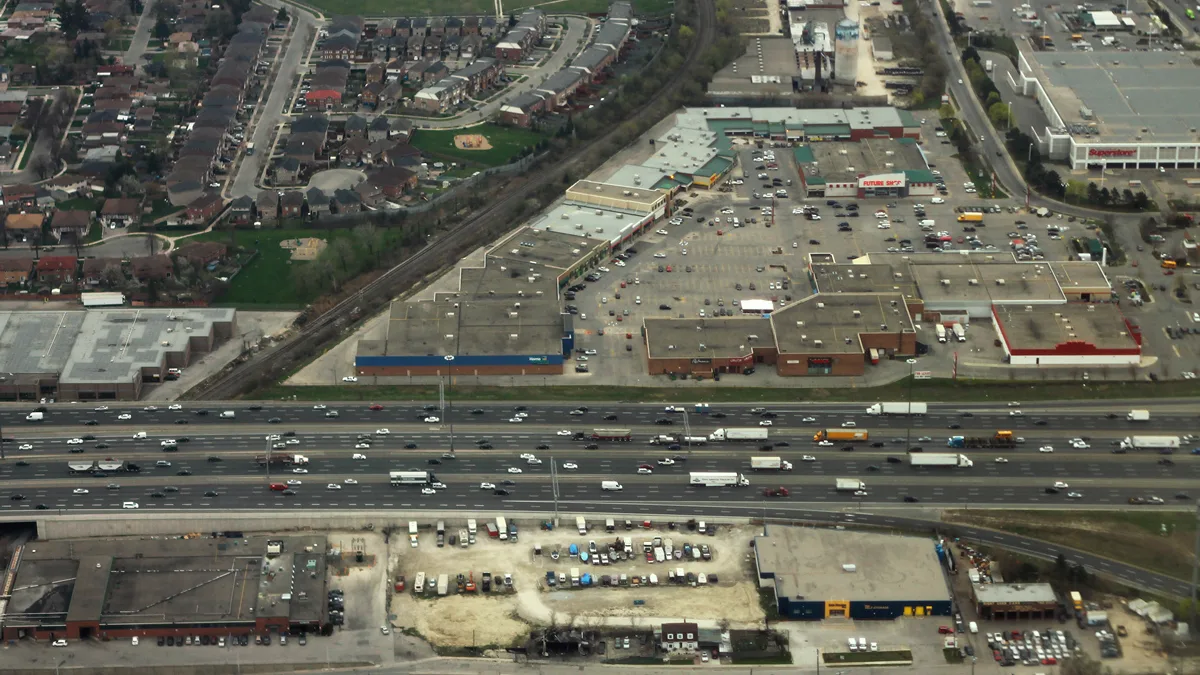
Cars, Commuting And Car Dependency
| First created | Mid-20th century |
|---|---|
| Country of origin | United States |
| Original use | Enabling suburban living and dispersed urban development |
| Cultural context | Post-World War II North American and later global urban planning |
| Key characteristic | Land-use patterns requiring private vehicles for daily needs |
| Associated infrastructure | Low-density zoning, highways, parking lots |
| Common critique | Limits mobility for non-drivers and increases environmental impact |
Origin and history
The phenomenon of car dependency originated in the United States in the early to mid-20th century, following the widespread adoption of the automobile. Its development was not a single event but a gradual process shaped by post-World War II urban planning and industrial policy. A key historical driver was the deliberate construction of the Interstate Highway System beginning in the 1950s, which prioritized high-speed road connections between and through cities. Concurrently, zoning laws increasingly separated residential areas from commercial and industrial uses, making walking or transit impractical for daily needs. The decline of streetcar systems, often influenced by automotive and oil industry interests, further eroded alternative transportation options. This combination of infrastructure investment, land-use policy, and industrial lobbying established a physical and legal framework where car ownership transitioned from a convenience to a practical necessity for most households.
What it is for
Car dependency serves as the foundational system for personal mobility and economic access within the built environments it creates. Its primary function is to enable residents to perform essential daily activities, including traveling to workplaces, schools, and healthcare facilities that are often separated by large distances. The system is designed to facilitate access to goods and services, such as grocery stores and retail centers, which are typically consolidated in automobile-accessible locations like shopping malls and strip developments. It supports the logistical model of just-in-time delivery and the geographic dispersion of supply chains that underpin modern consumer economies. For municipal governments, car-centric infrastructure has historically been a tool for enabling low-density suburban expansion and managing urban growth patterns. The system also functions as a significant cultural signifier, where the car is intertwined with notions of autonomy, privacy, and social status.
What does Cars, Commuting And Car Dependency mean
Cars, Commuting And Car Dependency describes a socio-technical system where the private automobile is the dominant and often structurally necessary mode of transportation for a majority of the population. It signifies a land-use pattern, commonly termed sprawl, where destinations are too dispersed and roads too hostile for efficient walking, cycling, or public transit. The term "dependency" explicitly indicates a condition of limited effective choice, where individuals and households must bear the substantial financial and logistical burdens of car ownership to participate fully in society. It reflects a policy environment that has consistently prioritized road capacity and parking provision over investments in alternative infrastructure for decades. This phenomenon creates a feedback loop where new development is designed to accommodate expected car traffic, thereby reinforcing the need for cars and generating more traffic. Ultimately, it represents a specific outcome of industrial, planning, and political choices that have physically shaped cities and lifestyles.
Cars, Commuting And Car Dependency meaning
The cultural meaning of this phenomenon extends beyond mere transportation into realms of identity, freedom, and constraint. It embodies a postwar ideal of individual freedom and suburban domesticity, where the car symbolizes personal autonomy and control over one's schedule and route. Commuting by car has become a normalized, if often resented, daily ritual that structures time and consumes a significant portion of household income. Dependency carries a critical connotation, highlighting the vulnerability and burden imposed by a system that requires large capital expenditures on vehicles, fuel, insurance, and maintenance as a condition of citizenship. Culturally, it speaks to the adaptation of social life around automotive travel, from drive-through services to the decline of walkable public spaces. The phenomenon also signifies environmental and health impacts, representing a major source of greenhouse gas emissions, air pollution, and sedentary lifestyles.
Why is Cars, Commuting And Car Dependency popular
The popularity and persistence of this system are not primarily due to public preference but to its entrenched, path-dependent nature and the perceived lack of feasible alternatives. It became popular initially because it offered unprecedented personal mobility and the promise of a new, modern lifestyle away from crowded industrial cities, heavily marketed by the automotive and related industries. Governments promoted it through massive public investment in road infrastructure and mortgage policies favoring single-family homes, making the car-dependent lifestyle financially accessible to middle-class families in the mid-20th century. Its continued dominance is sustained by the immense sunk costs in existing infrastructure and development patterns, making systemic change prohibitively expensive and politically challenging in the short term. The system also creates powerful economic interests, from automakers to oil companies to real estate developers, who have a vested stake in its continuation. Furthermore, for those living within it, the immediate convenience and door-to-door service of a car often feel superior to underfunded or non-existent alternatives, creating a pragmatic, if reluctant, acceptance.
Pros and cons
A primary pro of this system is the high degree of point-to-point personal mobility and schedule control it provides within its own framework, allowing for spontaneous trips and the transport of passengers or goods. It enables living in lower-density environments that some individuals prefer for perceived privacy, space, and quiet. The cons, however, are substantial and systemic. The common financial mistake is underestimating the true total cost of ownership, which includes depreciation, insurance, fuel, maintenance, and parking, often constituting a household's second-largest expense after housing. Individuals who regret their dependency typically include those who are too young, old, disabled, or financially strained to drive, effectively rendering them immobile. The system generates significant negative externalities, including traffic congestion, which wastes time and fuel, and a high incidence of injuries and fatalities from collisions. It creates sedentary lifestyles linked to health issues and contributes heavily to air pollution and carbon emissions. Furthermore, it can isolate communities, reduce casual social interaction, and make neighborhoods less safe for pedestrians and children.
Who it suits
This system best suits individuals with stable, middle-to-high incomes who can absorb the significant and recurring costs of purchasing, insuring, fueling, and maintaining one or more personal vehicles. It is suited to households where all able-bodied adults hold valid driver's licenses and where no members have conditions that preclude driving. The car-dependent model aligns with preferences for single-family homes with private yards in low-density subdivisions, prioritizing private space over proximity to communal amenities. It functions adequately, though with growing strain, for those whose daily travel patterns are relatively simple, such as commuting from a suburb to a job in a commercial park or downtown area with ample parking. The system is less suitable and often actively hostile to children, teenagers, the elderly, individuals with certain disabilities, and low-income households for whom car ownership is a severe financial burden. It is fundamentally mismatched with goals of environmental sustainability, public health promotion, or fostering dense, socially interactive urban communities.