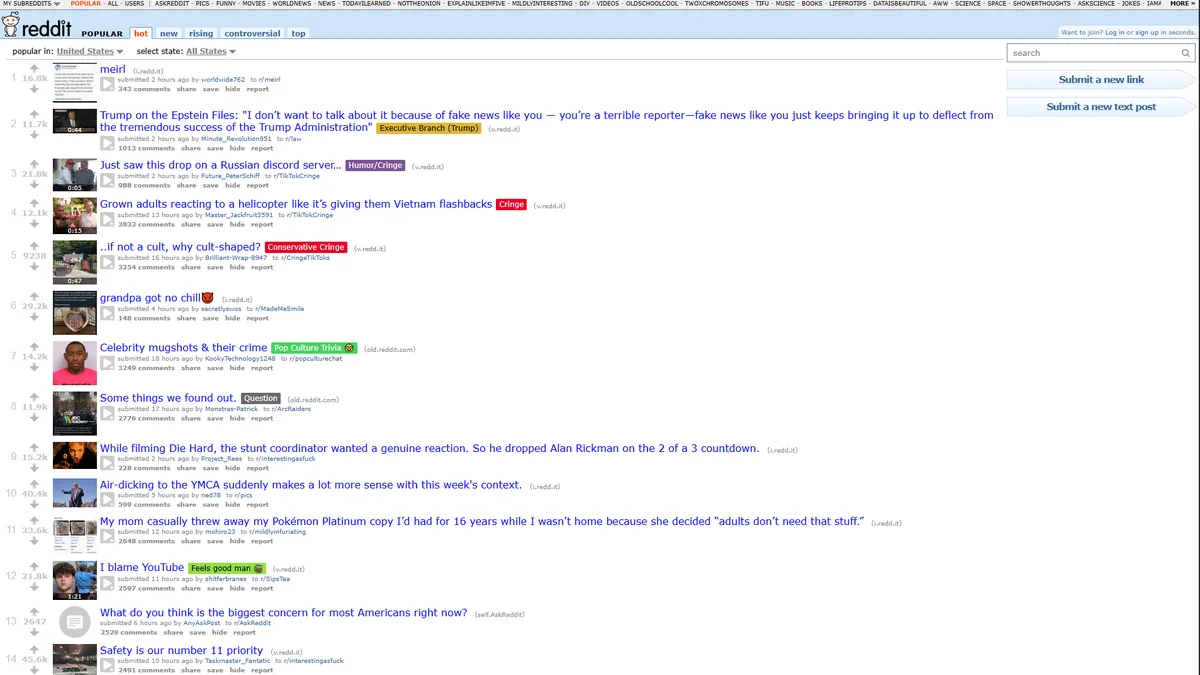
| Site context | Internet community and discussion website |
|---|---|
| Original use | Online community for sharing links and discussion |
| First created | 2005 |
| Founders | Steve Huffman, Alexis Ohanian, Aaron Swartz |
| Primary user base | Wide range of internet users seeking communities (subreddits) around specific topics |
| Content structure | User-submitted posts organized into topic-specific forums (subreddits) |
| Governance model | Moderated by volunteer community moderators |
Origin and history
Reddit originated in the United States and was launched in the mid-2000s. It was created by university students Steve Huffman and Alexis Ohanian as a platform for sharing links and news. The site's name is a play on the phrase "I read it," indicating its initial focus on content aggregation. In its early years, Reddit operated as a simple list of user-submitted links, with community voting determining their visibility on the homepage. The introduction of user-created subreddits, distinct forums dedicated to specific topics, was a pivotal development that transformed the site from a single feed into a vast collection of micro-communities. This architectural shift allowed Reddit to scale and diversify far beyond its original concept, enabling it to host discussions on virtually any niche interest. Over the subsequent decades, the platform evolved through numerous redesigns, the introduction of a real-time chat feature, and the launch of a monetary reward system for content creators, while its core mechanics of voting, commenting, and community moderation remained central.
What it is for
Reddit functions as a massive, user-driven aggregation of online communities centered around specific topics, known as subreddits. Its primary purpose is to facilitate discussion, information sharing, and content curation through a system of upvotes and downvotes that ranks contributions. Users visit the site to seek advice on specialized hobbies, follow breaking news developments often accompanied by eyewitness accounts, and participate in deep, threaded conversations on topics ranging from academic science to popular entertainment. It serves as a real-time forum for technical support, where communities dedicated to software, hardware, and gaming provide collective troubleshooting. Furthermore, the platform acts as a cultural barometer and meme incubator, where trends, jokes, and social commentary are frequently generated and disseminated to the wider internet. For many, it is a primary source of highly niche information and peer validation, whether concerning personal finance strategies, rare medical conditions, or obscure historical facts, all filtered through the lens of community consensus.
Pros and cons
The voting system can efficiently surface the most helpful or entertaining content from a large volume of submissions, reducing noise for casual visitors. However, a major con is the potential for echo chambers and groupthink within subreddits, where dissenting opinions can be downvoted into invisibility, reinforcing a community's biases. The platform's anonymity can foster supportive environments for sensitive discussions but also enables trolling, harassment, and the spread of misinformation with limited accountability. A common mistake for new users is to engage without first understanding a subreddit's specific culture and rules, often leading to negative reactions or bans. Many users regret the considerable time investment the "infinite scroll" interface encourages, and the experience can be negatively impacted by sporadic moderation quality, which varies drastically from one community to another, leading to inconsistent enforcement of site-wide rules.
Who it suits
Reddit best suits individuals seeking unfiltered, crowd-sourced information and those who enjoy participating in community-driven discussion rather than following individual influencers. It is particularly valuable for hobbyists, enthusiasts, and professionals looking for deep dives into specialized topics, from woodworking and programming to academic research fields. The platform appeals to users who prefer text-based, asynchronous communication and who derive satisfaction from contributing to a collective knowledge base through detailed comments or answers. It also suits those interested in the early formation of internet culture and meme trends, as many originate within its communities. Conversely, it is less suited to individuals sensitive to abrasive online discourse or those seeking a consistently polished, advertiser-friendly web experience. Users who require authoritative, vetted information for critical decisions may find the anonymous, consensus-based model insufficiently reliable without careful cross-referencing from external sources.