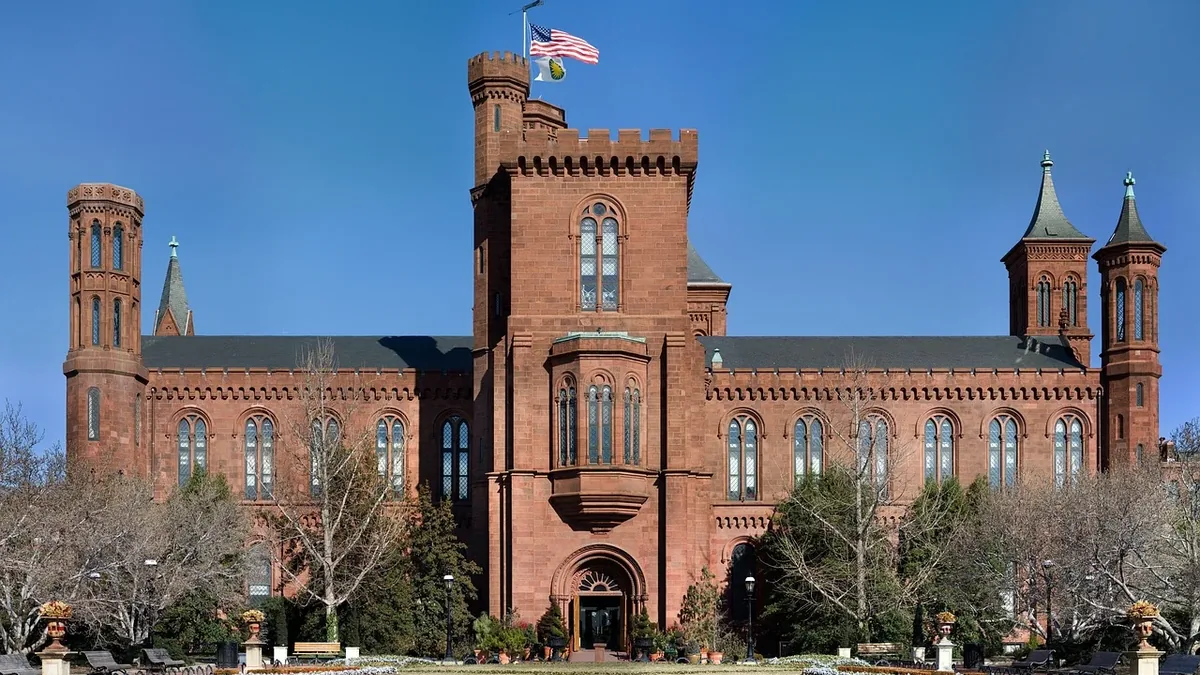
Smithsonian
| Founded | 1846 |
|---|---|
| Headquarters | Washington, D.C., United States |
| Governing body | Board of Regents |
| Members | 19 museums, 21 libraries, 9 research centers |
| Collection size | Over 150 million objects |
| Primary funding | Federal appropriation and private donations |
| Public access | Free admission to all museums and the National Zoo |
Overview
The Smithsonian Institution is a vast museum, education, and research complex administered by the United States government. It is not a single museum but a collection of museums, galleries, zoos, and research facilities, primarily located in Washington, D.C. Its core mission is the increase and diffusion of knowledge across a wide range of scientific, historical, artistic, and cultural disciplines. The Institution holds over 154 million items in its collections, ranging from historic aircraft and dinosaur skeletons to fine art and cultural artifacts. It serves a global audience of researchers, students, and the general public, offering free admission to most of its public venues. The Smithsonian's scale and scope make it one of the world's most significant repositories of human and natural history.
History
The Smithsonian Institution was established in the United States in the mid-19th century, following a bequest from James Smithson, a British scientist who had never visited America. Smithson's 1829 will left his fortune to the United States to create an establishment for the "increase and diffusion of knowledge." After a decade of congressional debate, the Institution was officially founded by an act of Congress and signed into law by President James K. Polk in 1846. Its first building, the Smithsonian Institution Building often called "The Castle," was completed in 1855 on the National Mall. The early Institution focused on scientific research and the creation of a national museum, with its first secretary, Joseph Henry, emphasizing a program of original research and publication. Throughout the late 19th and 20th centuries, it expanded dramatically, adding major museums like the National Museum of Natural History and the National Air and Space Museum, evolving into the cultural complex known today.
How it works today
The Smithsonian operates as a trust instrumentality of the United States, receiving federal appropriations for its core operations while also relying heavily on private donations, grants, and revenue from its retail and publishing arms. It is governed by a Board of Regents, which includes the Chief Justice of the United States, the Vice President, members of Congress, and private citizens. The day-to-day operations are managed by a Secretary, who oversees the directors of the individual museums and research units. Its public-facing operations include 21 museums, the National Zoo, and numerous research centers, with most museums on the National Mall offering free admission to all visitors. Behind the scenes, thousands of scientists, historians, curators, and conservators conduct research, care for the immense collections, and develop educational programs. The Institution also maintains extensive digital archives and online exhibitions, extending its educational mission to a worldwide virtual audience.
Pros and cons
A primary advantage of the Smithsonian is its unparalleled scale and the depth of its collections, allowing for comprehensive exploration of almost any topic within its domains. The policy of free admission to its major museums removes financial barriers to cultural and scientific education, making it uniquely accessible. However, the sheer size can be overwhelming for visitors, leading to museum fatigue where one cannot meaningfully engage with more than a fraction of the offerings in a single day. The reliance on a mix of federal and private funding can sometimes lead to tensions between scholarly independence and the interests of donors or political overseers. Some critics argue that the Institution's bureaucratic size can slow decision-making and make it slow to respond to contemporary issues or to refresh longstanding exhibits. A common mistake for first-time visitors is attempting to see multiple large museums in one day, resulting in a superficial experience rather than a deep engagement with any one collection.
Who it suits
The Smithsonian suits researchers and academics across numerous fields, who benefit from its archival holdings, specialized libraries, and fellowship programs. It is ideal for students of all ages, from school groups on educational trips to lifelong learners taking advantage of its lectures, workshops, and detailed exhibit texts. Casual tourists with a broad interest in history, art, or science will find iconic artifacts and world-class exhibitions, though they benefit from strategic planning to avoid overload. Families find it particularly suitable due to the variety of interactive exhibits, the appeal of the National Zoo, and the cost-free access. It also serves dedicated enthusiasts, such as aviation buffs at the Udvar-Hazy Center or art historians at the American Art Museum, who can delve deeply into niche collections. Ultimately, it suits anyone seeking authoritative, well-presented information and objects that tell the story of the natural world and human culture.
Latest Smithsonian news
Latest reporting
Trump Demands Removal of 'Infinity' Sculpture for Washington
President Donald Trump has demanded the Smithsonian replace a 1967 modernist sculpture with a 30-foot statue of George Washington, criticizing the

Smithsonian Secretary Lonnie Bunch Announces Retirement
Lonnie G. Bunch III will retire as Smithsonian Secretary at year's end after a 38-year career, highlighted by founding the National Museum of African