Minnie Evans Whitney Exhibit Explores Artist's 'Lost World'
A major exhibition of Minnie Evans's work is on view at the Whitney Museum until January.
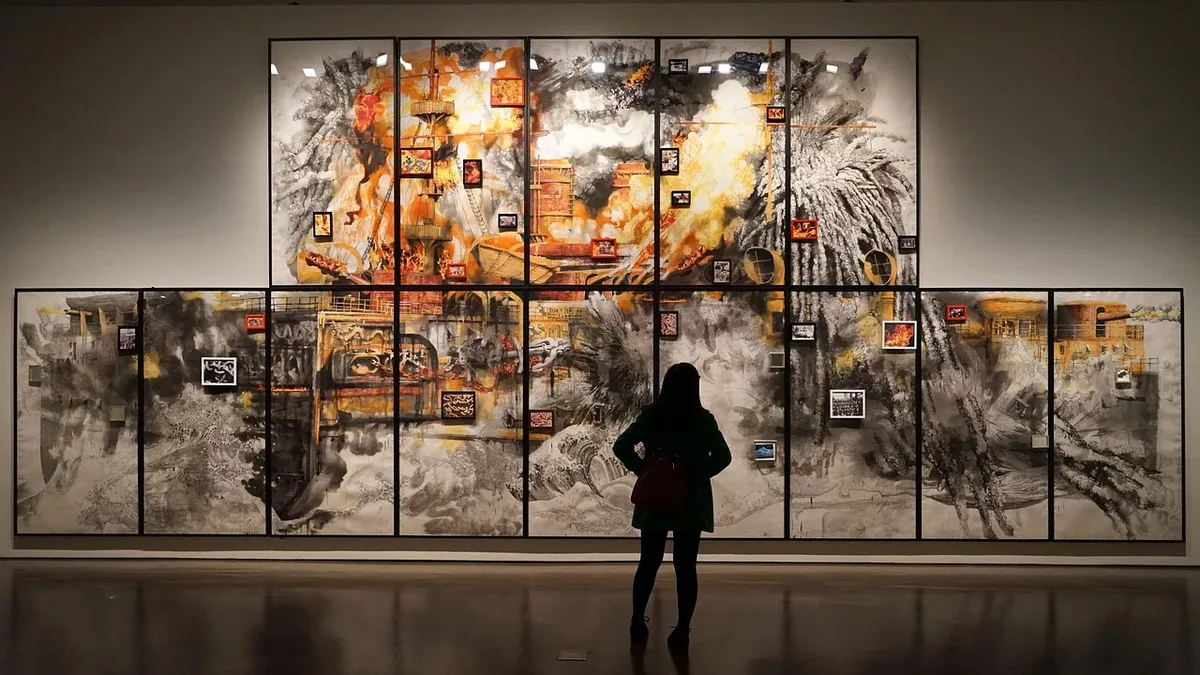
A major exhibition of nearly one hundred paintings and drawings by Minnie Evans is on display on the eighth floor of the Whitney Museum of American Art until January of next year. The show, titled "The Lost World: The Art of Minnie Evans," was organized by curator Barbara Haskell in New York, following initial work by curator Katherine Jentleson in Atlanta.
The artist's work presents a fierce, paradisiacal area. Her compositions are overloaded with mandalas, expressionless floating heads, horned mammals, and scaled serpents, all rendered in voluble pinks, greens, and oranges. The drawings, often made with pencil and crayon on brown pulp paper, feature a sparse grove of trees at the bottom, barely suggesting a physical world from which her psychedelic beings seem to spring forward.
The Controversial 1975 Solo Show
The current Whitney exhibition echoes a past presentation. In 1975, photographer Nina Howell Starr guest-curated a solo show of Evans's work at the museum, making Evans the third Black woman to have a solo show there. This move sparked controversy within the cosmopolitan Black art scene. Protesters, who had been calling for modern art museums like the Whitney to exhibit more work by Black artists, saw Evans's inclusion as an insult when compared to an innovative star like Alma Thomas, the first Black woman to get a Whitney solo show.
Critics labeled Evans as "primitive," a double-edged epithet. Some in Black critical circles viewed her fantastical Biblical scenes, which sometimes depicted angels and Christ as chalky white, as a sign of backwater unsophistication. According to the source, Evans herself had "no truck with polemics." She was described as the highest level of abstractionist, distilling humanity to a point before race and before war.
A Life of Visions and Labor
Minnie Evans was born in 1892 in Wilmington, North Carolina, to a thirteen- or fourteen-year-old mother named Ella and was raised primarily by her grandmother, Mary Croom Jones. She married Julius Evans at sixteen, lying about her age to do so, and had sons. The family worked as domestic servants at the Pembroke Estate in Wilmington.
Throughout her life, Evans was besotted by turbulent, pictorial dreams. She spoke of dreaming of a "lost world," the multitude of nations lost to the Great Flood. After her grandmother Mary Croom Jones died in the mid-1930s, Evans entered a troubled state. She reported that a voice told her to draw her visions or die. Her first work, "My Very First," was an elliptical pen-and-ink drawing of a solar eye made on the back of a grocery list in 1935. Her dreaming sometimes exhausted her as a mother and caused her to miss church, leading a pastor to scold her husband, Julius, telling him to let her be.
Discovery and Interpretation
In her late fifties, Evans became the gatekeeper at Airlie Gardens in Wilmington, where she sold her drawings and attained a growing legend. Her "discovery" by photographer Nina Howell Starr in the early 1960s coincided with a rising romance for the untaught artist. Starr acted as custodian, archivist, and chief interlocutor, putting Evans's work through "the grind of interpretation" at the artist's own request.
Exhibitions were organized at churches and galleries in New York City. Scholars hazarded theories about how an unschooled middle-aged Black woman from the South could brush with genius, with one critic deeming her an "innocent surrealist." Recent scholarship, including in a documentary titled "Minnie Evans: Draw or Die" and a monograph by Katherine Jentleson, Kim Conaty, and María Elena Ortiz, grapples with the sources of her imagery. They consider connections to Buddhist iconography, Caribbean-Surrealist poetics, and family lore, including a matriarchal ancestor named Monie who had been enslaved in Trinidad. Evans also became obsessed with Fu Manchu films, which scholars note explains the Chinese faces that sometimes appear in her work.
Yet, as the source states, all the biographical detail and scholarly theorizing "cannot complete the math." The article concludes by reflecting on a man who once bought a drawing by Evans but returned it, unable to handle being in its space-an act described as a gesture of sensitivity and respect that might not have been an affront to the artist, who herself felt knocked off axis by the energy of her own yield.