George Lucas unveils Lucas Museum of Narrative Art in Los Angeles
After decades of development and failed attempts in San Francisco and Chicago, George Lucas and Mellody Hobson have opened the Lucas Museum of Narrative Art in Los Angeles.
The Lucas Museum of Narrative Art has opened in Los Angeles after eight years of construction following a groundbreaking in 2018. George Lucas described the project as one that "almost broke my will" despite his history of achieving the impossible. The museum aims to be a sign of visual storytelling across all kinds of media, paintings, comics, murals, photography, sculpture.
It offers 100,000 sq ft of gallery space featuring works by artists such as Judy Baca, Norman Rockwell, Diego Rivera, and Banksy, alongside items like the Wizard of Oz’s Cowardly Lion costume and drawings of Asterix and Garfield. Mellody Hobson, Lucas’s wife and co-founder, stated that what unites these diverse works is their function: to tell a story, often in a single frame.
Ryan Linkof, the museum’s senior curator, described visual storytelling as "the art that surrounds us" and "the art in the visual history that we assume every day, often without even realizing it." He cited newspaper photographs, advertisements, book covers, comic books, posters, street art, and movies as examples.
The museum is divided into two sections: one containing most galleries and a pair of cinemas, and the other housing the mural collection and a research library. Designed by Ma Yansong, the building’s flying-saucer-like shape invites comparisons to Star Wars, though the architect said he was inspired more by tree canopies and clouds. A plaza between the sections includes an oculus, a round opening allowing visitors to "see the sky and the universe."
Lucas began collecting art in the 1970s and, over time, combined his collection with Hobson’s. About 20 years ago, he began working toward the museum’s creation, according to Tracey Bates, the museum’s CEO. Earlier plans to build in San Francisco or Chicago failed before the project broke ground in Los Angeles in 2018. Hobson said LA is "where we believe we were always meant to be," and Bates agreed, noting that "the largest, most popular form of narrative art is cinema. So what better space for it to be than the home of storytelling?"
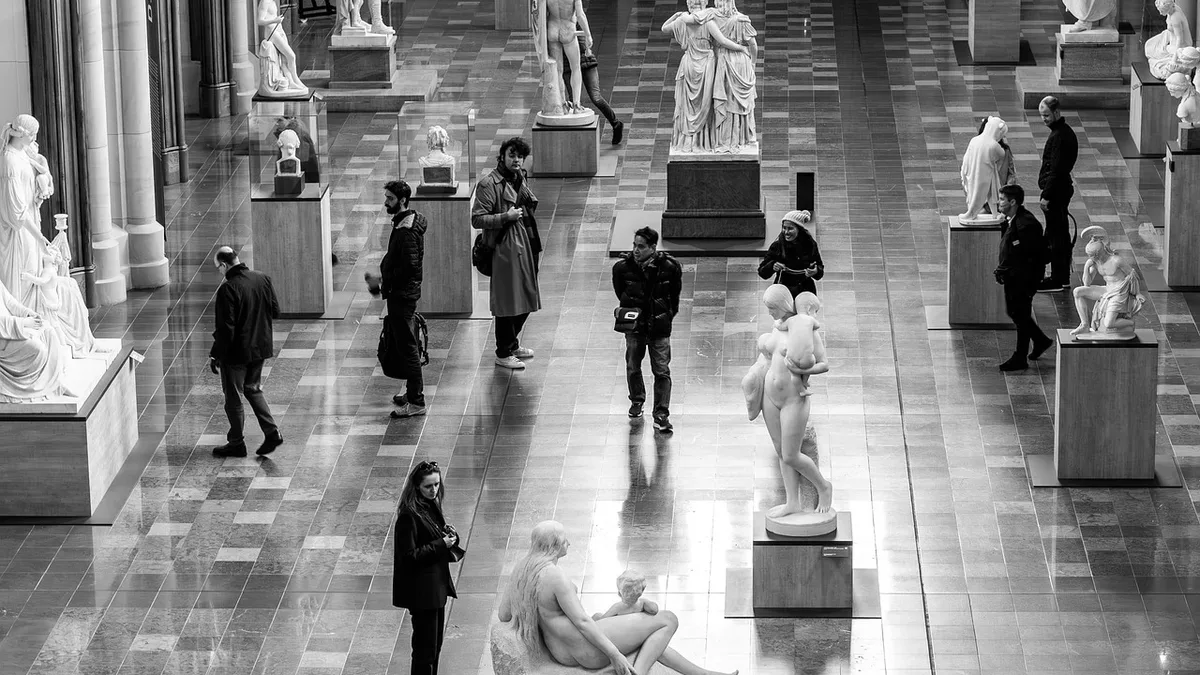
The ground floor features an immersive reproduction of cave paintings, followed by paintings, mosaics, and sculptures depicting stories from ancient civilizations and the Bible, setting historical context for the core collection from the 20th and 21st centuries. Visitors reach the upper galleries via round glass elevators.
Galleries are organized by medium, theme, artist, and genre. Medium-based rooms include a comics room with strips from Krazy Kat, Little Orphan Annie, The Adventures of Tintin, and Superman; a children’s stories room with art from Where the Wild Things Are and fairytale illustrations; and a manga room featuring Astro Boy and a portrait of Pikachu.
Theme-based rooms include a "community" area with neighborhood scenes by Ernie Barnes and a Frida Kahlo self-portrait; a "childhood" area with a Margaret Keane painting, Children of Paris, and a Picasso drawing titled Little Girl; and a "civic life" area with photography of a 1968 sanitation workers’ strike and a painting by Shepard Fairey and Ernesto Yerena Montejano opposing immigration raids.
Other galleries focus on single artists such as NC Wyeth, Jessie Willcox Smith, and Maxfield Parrish, or genres like science fiction, fantasy, and adventure. While not a Star Wars museum, it includes an exhibit on transportation in the films, featuring vehicle models, production artwork, and costumes, with additional subtle nods to the franchise throughout.
The mural room contains significant works, including a video tracing Judith Baca’s mural of the Los Angeles River’s history, extracted Banksy wall pieces, and a large image of JR’s Kikito showing a child looking over the US-Mexico border wall. Each work has a small plaque with title, year, artist, and materials, but there are no lengthy descriptions on the walls.
Ryan Linkof said this absence of interpretive text was deliberate: Lucas and the curators wanted to avoid a "heavily mediated" experience and instead encourage visitors to have "their own individual encounters with works of art and take away what they feel like speaks to them." Those seeking context can scan images with their phones for brief descriptions.
Tracey Bates emphasized that many featured artists, such as John Romita Jr. For his Spider-Man panels, often lack institutional respect despite their storytelling significance. She noted that Norman Rockwell "was not considered an artist, more an advertising illustrator" in his day, but is now seen as one of the museum’s greatest storytellers. Bates concluded by asking, "How many of us here in this room have learned to face our fears because of the work of Maurice Sendak, or learn moral lessons while studying EH. Shepard’s drawings of the 100 Acre Wood?" and affirmed that Lucas calls this "People’s Art," with the museum as its home.